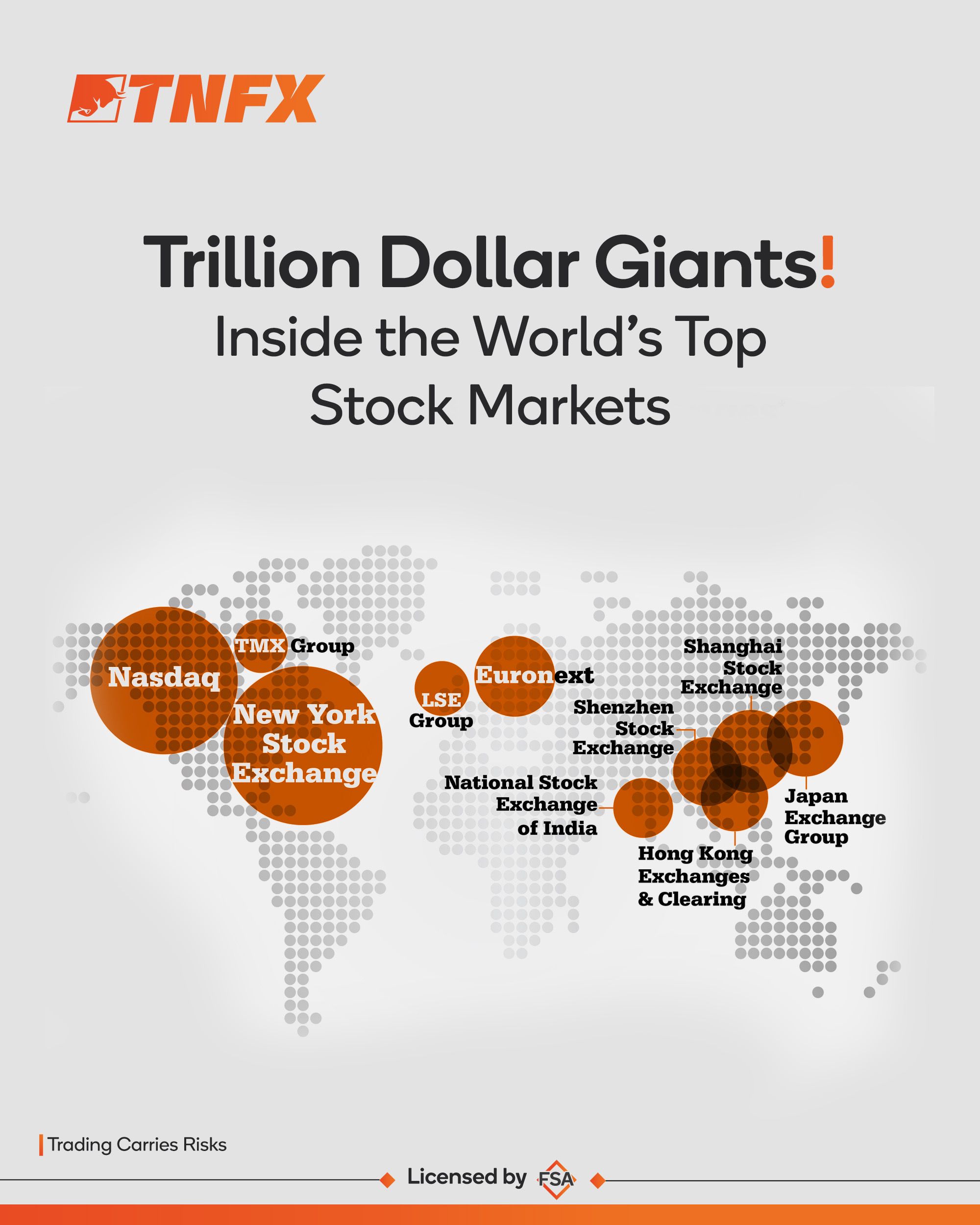
In today’s world, 16 major stock exchanges are classified within the so-called “Trillion Dollar Club,” each with a market capitalization exceeding one trillion U.S. dollars. Economists often describe global exchanges as the backbone of international financial exchange, accounting for approximately 87% of the world’s total market capitalization as of 2015.
Over the past year, global stock markets have witnessed remarkable growth in trading volumes, driven largely by the increasing dominance of major economic powers on the global financial scene.
Origins: How Did Global Stock Exchanges Begin?
To understand the different types of stock exchanges, it’s essential to explore the origins of the concept. The earliest forms of stock exchange trace back to the Belgian city of Antwerp, where European merchants would meet to set prices and finalize trade deals.
The name “de Beurze” became associated with these gatherings, attributed to a businessman who helped organize pricing standards effectively resolving disputes and fostering smoother trade. Over time, “Beurze” evolved into the term “bourse,” which is now synonymous with stock exchanges across many languages.
These merchant meetings gradually evolved into structured institutions with designated trading floors, and the concept spread globally. Eventually, the emergence of technology propelled these exchanges into the digital realm, giving rise to the modern “global stock markets” we know today.
Types of Global Stock Exchanges: The U.S. as a Model
The United States plays a leading role in shaping global financial markets, owing to its political and economic strength. Initially, U.S. stock trading involved face-to-face interactions between buyers and sellers. As time progressed, markets transitioned into sophisticated electronic systems that allow real-time trading of stocks and bonds remotely.
This digital evolution elevated the U.S. exchanges to a new level of professionalism, making them among the most influential in the world.
U.S. Stock Exchanges: History and Global Impact
Among the world’s top exchanges, American stock markets stand out as key players in the global financial system, thanks to their strong infrastructure and the sheer number of listed companies.
1. New York Stock Exchange (NYSE)
Located on Wall Street in New York City, the NYSE is one of the largest stock exchanges globally. It ranks second in number of listed companies—housing over 2,764 firms and boasts a market capitalization nearing $25 trillion.
Though NASDAQ was founded earlier, the NYSE surpasses it in value, being nearly five times larger in terms of market cap. A major milestone in its history was the merger with Europe’s Euronext, forming the NYSE Euronext—the world’s first global exchange platform.
The NYSE relies on key economic indicators, including:
Dow Jones Industrial Average: Tracks the performance of 30 major industrial companies in the U.S.
S&P 500: Represents 500 of the largest publicly traded companies and is a crucial tool for market analysis.
2. NASDAQ
Founded in 1971, NASDAQ is the largest electronic trading platform in the U.S. and a favorite for tech and growth-oriented companies due to its accessible structure and innovation-friendly regulations.
In response to the 1987 market crash, NASDAQ introduced the SEOS system (Small Order Execution System), which greatly improved trading efficiency. Over the years, it expanded its reach through strategic mergers, including a partnership with the London Stock Exchange, solidifying its international credibility.
European Stock Exchanges: Historical and Economic Powerhouses
Europe’s financial markets are equally significant, known for their deep history and trading volume. Leading exchanges include:
London Stock Exchange (LSE): One of the oldest in the world, with global influence across energy, metals, and financial services.
Euronext: A unified European exchange that spans France, the Netherlands, Belgium, Portugal, and Ireland. It enhances market integration across the continent.
Other notable European exchanges include:
1. Paris Stock Exchange: Now part of Euronext, it excels in luxury, energy, and tech sectors.
2. Frankfurt Stock Exchange: The largest in Germany, home to giants like Siemens, BMW, and Bayer.
3. Borsa Italiana (Milan Stock Exchange): Focused on banking and industry, now under the Euronext umbrella.
4. Madrid Stock Exchange: Spain’s main exchange, linked closely with Latin American companies.
Asian and Pacific Stock Exchanges
Moving eastward, the Asia-Pacific region hosts some of the most dynamic and valuable exchanges worldwide. Their currencies and economies exert strong global influence.
1. Tokyo Stock Exchange (TSE): Asia’s largest and the world’s third-largest by market cap. Home to giants like Toyota and Sony.
2. Hong Kong Stock Exchange: A strategic gateway to Chinese markets, known for liberal policies and international appeal.
3. Singapore Exchange (SGX): Compact but highly active, with a focus on tech, energy, and banking sectors.
These exchanges are sensitive to geopolitical shifts, particularly U.S. policies, with noticeable market volatility during American election cycles.
Australian Securities Exchange (ASX)
Australia’s main exchange is located in Sydney and ranks among the world’s top financial markets in market capitalization. It specializes in mining, energy, and financial services, attracting both local and international investors.
Trading in Global Markets
Thanks to digital advancement, trading is no longer limited to physical trading floors. Investors can now trade via computers or smartphones with a reliable broker and a professional liquidity provider.
Global markets offer a wide array of financial instruments—including stocks, bonds, precious metals, and currencies—broadening investment opportunities.
Global Market Trading Hours
Each stock exchange operates on a fixed schedule, usually based on GMT. Knowing your local equivalent allows for efficient monitoring and decision-making.
The staggered opening hours of these exchanges give traders the flexibility to participate at different times, making global trading accessible around the clock.
Forex Market Trading Hours
The Forex market—the world’s most liquid and active financial market operates around the clock, segmented into four major trading sessions:
• Sydney
• Tokyo
• London
• New York
Each session spans about eight hours, allowing 24-hour access during weekdays. Understanding these times is key to avoiding low-liquidity periods and capitalizing on peak trading hours.
With this comprehensive guide, you’re ready to explore the world of global markets—whether you’re just starting out or an experienced investor. The financial world is now within your reach. All that’s left is one step: choose your broker and begin your investment journey with confidence.